Sample routes from the Oxford (Cowley) Driving Test Centre
Oxford driving test routes.
Three sample routes based on roads commonly used by DVSA examiners. Your actual test route will be different, but it’s likely to include similar roads, junctions and driving conditions.
Blackbird Leys & Rose Hill.
Residential roads, busy urban streets, double mini roundabouts, a short section of dual carriageway and a large multi-lane roundabout.
Road types
- Residential roads
- Busy urban driving
- Short dual carriageway
- Double mini roundabouts
- Large roundabouts
Key skills
- Forward planning
- Lane discipline
- Meeting traffic
- Roundabouts
- Speed judgement
- Traffic lights
- Observation
- Dual carriageway joining
Route
- Oxford (Cowley) Driving Test Centre — Turn left.
- James Wolfe Road — Turn left.
- Hollow Way — Turn left.
- Cranmer Road — Turn right.
- Rupert Road — Turn left.
- Horspath Road — Turn right.
- Wilkins Road — Turn right.
- Marshall Road — At the end of the road, turn left.
- Hollow Way — Continue to the end of the road. Turn left onto Garsington Road.
- ARC Oxford Roundabout — 2nd exit (straight ahead).
- Cowley Junction (Tesco) Roundabout — 2nd exit towards Watlington and Blackbird Leys (B480).
- Garsington Road — Continue to the second set of traffic lights. Turn right.
- Cuddesdon Road — Take the second road on the left.
- Pegasus Road — Continue past Blackbird Leys Leisure Centre. Turn right.
- Blackbird Leys Road — First mini roundabout — straight ahead (2nd exit).
- Second mini roundabout — Straight ahead (1st exit).
- Next mini roundabout — 1st exit left.
- Sandy Lane West — Continue to the end of the road and join the A4142 Eastern Bypass via the short slip road.
- A4142 Eastern Bypass — Continue to Littlemore (Rose Hill) Roundabout.
- Littlemore (Rose Hill) Roundabout — 3rd exit towards Rose Hill and Iffley.
- Oxford Road — Continue straight ahead.
- Rose Hill traffic lights — Turn right.
- Church Cowley Road — Continue to the second set of traffic lights. Turn right.
- Garsington Road — Turn left.
- Hollow Way — Turn right.
- James Wolfe Road — Turn right.
- Oxford (Cowley) Driving Test Centre — Finish.
Instructor tips
Roundabouts
ARC Oxford & Cowley Junction.
These two busy roundabouts require good forward planning and lane discipline. Read the road signs and lane markings early, choose the correct lane in good time and avoid late lane changes.
Mini roundabouts
Treat them as separate junctions.
Treat the double mini roundabouts as two separate junctions, not one continuous hazard. After the first, reassess before approaching the second — reduce speed, make fresh observations and be prepared to give way.
Joining the A4142
A very short slip road.
It will often not be safe to join immediately, so be prepared to stop and wait for a suitable gap. As you may need to accelerate from a standstill, make sure traffic is far enough away before joining.
Littlemore
Rose Hill Roundabout.
Approach in the right-hand lane for the 3rd exit towards Rose Hill and Iffley. Read the lane markings on approach, maintain lane discipline throughout and move back to the left only when safe after exiting.
Headington & Hospitals.
Residential roads, busy urban streets, a high-speed dual carriageway, large roundabouts and one of Oxford’s busiest hospital areas.
Road types
- Residential roads
- Busy urban driving
- High-speed dual carriageway
- Large roundabouts
- Hospital routes
Key skills
- Forward planning
- Lane discipline
- Roundabouts
- Speed judgement
- Traffic lights
- Pedestrian crossings
- Bus lanes
- Anticipating emergency vehicles
- Hazard awareness
Route
- Oxford (Cowley) Driving Test Centre — Turn left.
- James Wolfe Road — At the end of the road, turn right.
- Hollow Way — Mini roundabout — 2nd exit.
- Horspath Driftway — At the traffic lights, turn left.
- Eastern Bypass Road (A4142) — Continue to Headington Roundabout.
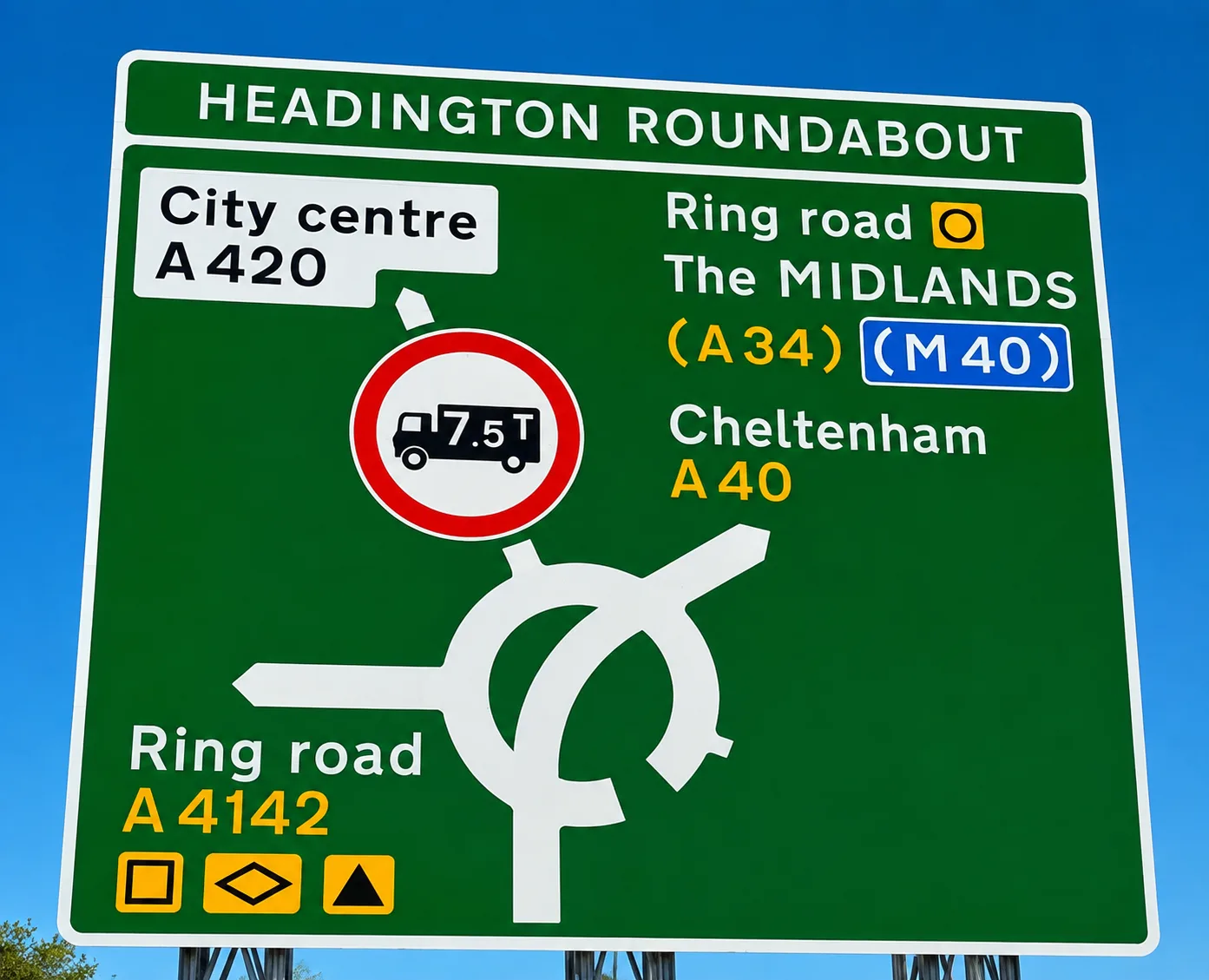
- Headington Roundabout — 3rd exit towards Marston and The Midlands (A40 West).
- North Way — Follow signs for Marston and the Hospitals.
- B4150 — Turn right.
- Marsh Lane — Turn left.
- Cherwell Drive — Traffic lights — straight ahead.
- Headley Way — Turn right.
- Woodlands Road — Continue ahead.
- Franklin Road — Turn right.
- Headley Way — Turn left.
- London Road — Continue to the crossroads traffic lights. Turn right.
- Windmill Road — Traffic lights — straight ahead.
- The Slade — Mini roundabout — 2nd exit.
- Hollow Way — 3rd exit left.
- James Wolfe Road — Turn right.
- Oxford (Cowley) Driving Test Centre — Finish.
Instructor tips
Headington
One of the busiest roundabouts.
Headington Roundabout is one of the busiest used on Oxford driving tests. Read the road signs and lane markings well in advance, choose the correct lane early and avoid late lane changes.
A4142
Eastern Bypass.
Traffic moves quickly along this section of dual carriageway. The speed limit reduces from 50 mph to 30 mph before Headington Roundabout — begin reducing speed early and avoid harsh braking at the last moment.
Woodlands Road
Bends and limited visibility.
Take extra care where the road bends and visibility can be limited. Maintain an appropriate speed and be prepared for vehicles, cyclists or pedestrians appearing unexpectedly.
Franklin Road
A double give-way junction.
Turning right into Headley Way, first give way to pedestrians and cyclists using the shared path, then to traffic on Headley Way. Remember the RALAR routine (Right, Ahead, Left, Ahead, Right) before moving off.
London Road
20 mph and bus lanes.
The 20 mph limit begins shortly after joining London Road. This section includes bus lanes, pedestrian crossings and heavy pedestrian activity around the hospitals and shops. Read the signs early and plan well ahead.
Emergency vehicles
Stay alert.
The test centre is close to Oxford Fire Station and this route passes several busy hospital entrances. Be prepared for emergency vehicles at any point — check your mirrors regularly and respond safely to sirens or blue lights.
Forest Hill & Barton.
Residential roads, fast and slow country roads, rural villages, a high-speed dual carriageway and large roundabouts.
Road types
- Residential roads
- Fast and slow country roads
- Rural villages
- High-speed dual carriageway
- Large roundabouts
Key skills
- Forward planning
- Lane discipline
- Meeting traffic
- Roundabouts
- Speed judgement
- Speed limit awareness
- Uphill move-off
- Rural driving
- Dual carriageway driving
Route
- Oxford (Cowley) Driving Test Centre — Turn left.
- James Wolfe Road — At the end of the road, turn right.
- Hollow Way — Mini roundabout — 2nd exit.
- Horspath Driftway — At the traffic lights, turn left.
- Eastern Bypass Road (A4142) — Continue to Headington Roundabout.
- Headington Roundabout — 5th exit towards London (A40 East), following signs for Islip.
- Wheatley Road (B4027) — Follow the road.
- B4027 — Turn left.
- Bayswater Road — Mini roundabout — 2nd exit.
- Stowford Road — At the end of the road, turn left.
- Underhill Circus — Second road on the left.
- Burchester Avenue — Turn left.
- North Way — Turn left.
- Edgecombe Road — Turn right.
- Bayswater Road — Continue to Headington (Green Road) Roundabout.
- Headington (Green Road) Roundabout — 2nd exit.
- Eastern Bypass Road (A4142) — First set of traffic lights — straight ahead.
- Eastern Bypass Road (A4142) — Second set of traffic lights — turn right.
- Horspath Driftway — Mini roundabout — 1st exit.
- Hollow Way — 3rd exit left.
- James Wolfe Road — Turn right.
- Oxford (Cowley) Driving Test Centre — Finish.
Instructor tips
A4142
Headington Roundabout.
The speed limit reduces from 50 mph to 30 mph before the roundabout, and the 30 mph limit remains in force after taking the exit towards London. A common mistake is accelerating too early — continue at 30 mph until the limit changes.
A40 slip road
Plan your exit early.
The slip road leaving the A40 is very short while traffic may be travelling at 70 mph. Plan your exit early, reduce speed progressively and avoid sudden or harsh braking as you approach.
Forest Hill
Changing speed limits.
Speed limits change frequently through this section — from 50 mph to 20 mph through Forest Hill, and from 60 mph to 30 mph on Bayswater Road. Stay alert for signs and adjust smoothly.
Underhill Circus
An unusual circular junction.
This layout can catch learners out if they’re unfamiliar with it. Look well ahead, read the road markings carefully and avoid last-minute steering decisions.
Edgecombe Road
Not a one-way street.
Some learners mistakenly believe Edgecombe Road is one-way and position on the right before turning. It is a two-way road, so approach the turn from the centre of your side of the carriageway.
Uphill move-off
Clutch control and observation.
This route includes a good location for practising uphill move-offs. Prepare the car before releasing the handbrake and prevent it rolling backwards — and while concentrating on clutch control, don’t forget your mirrors and blind spot.
Preparing for your driving test.
These are sample routes based on roads commonly used by DVSA examiners — your actual route will be different.
During your driving lessons with Oxford Intensive Driving School, you’ll practise a wide variety of test routes, helping you build the skills, confidence and experience needed to deal with whatever route the DVSA examiner chooses on test day.